
Ishan Institute of Management and Technology
BBA syllabus at Ishan Institute of Management & Technology

BBA Syllabus

Semester-wise syllabus of the Bachelor of Business Administration (BBA) programme — course codes, credits, unit-wise topics and suggested readings for every paper.

Duration
3 Years · 6 Semesters
Papers
20 Credits per Semester
Affiliation
CCS University, Meerut
Syllabus
CCSU NEP 2020 Syllabus, 2025-26

About the BBA Syllabus

Ishan Institute of Management & Technology follows the model curriculum for the UG degree in BBA prescribed by Chaudhary Charan Singh University, Meerut under the National Education Policy 2020, effective from the 2025-2026 session. Each of the six semesters of the three-year BBA carries 20 credits, and the programme allows multiple entry and exit — a UG Certificate after one year (44 credits), a UG Diploma after two years (84 credits) and the BBA degree after three years (124 credits), each exit including a mandatory 4-credit summer skill course or internship.

Courses are grouped into Major Discipline Specific Core Courses (MJDSCC), Major Discipline Specific Electives (MJDSEC), Minor Generic Electives (MNGEC), Skill Enhancement Courses (SEC), Ability Enhancement Courses (AEC) and Value Addition Courses (VAC). Semester I begins with a three-week compulsory induction programme.

Semesters V and VI include discipline specific electives in areas such as Finance, Marketing, HR, Business Analytics, Family Business, Entrepreneurship, Sports Management and Tourism and Travel Management, along with an internship or capstone project and a major project. The published CCSU PDF contains the detailed unit-wise syllabus for Semesters I and II and for Cost and Management Accounting (CC301); the other papers of Semesters III to VI are listed from the university's course structure.

BBA Subjects List – Semester-wise

Semester-wise scheme of papers for the BBA programme as per Chaudhary Charan Singh University, Meerut. Where a row offers a choice of papers or groups, students opt as indicated. Select a course code to jump to its detailed syllabus.

Semester I

Total: 20 Credits
Course CodePaper TitleCredits
CC101Principles and Practices of Management (MJDSCC)4
AEC101Business Communication-I (AEC)2
CC102Financial Accounting (MJDSCC)4
CC103Business Statistics and Logic (MJDSCC)4
AEC102General English-I (AEC)2
MDE101Indian Knowledge System (MNGEC)2
VAC101Environmental Science and Sustainability (VAC)2

Semester II

Total: 20 Credits
Course CodePaper TitleCredits
CC201Human Behaviour and Organization (MJDSCC)4
CC202Marketing Management (MJDSCC)4
CC203Business Economics (MJDSCC)4
SEC201Emerging Technologies and Applications (SEC)2
MDE201Media Literacy and Critical Thinking (MNGEC)2
VAC201Indian Constitution (VAC)2
AEC201Business Communication-II (AEC)2

Semester III

Total: 20 Credits
Course CodePaper TitleCredits
CC301Cost and Management Accounting (MJDSCC)4
MJDSCCLegal and Ethical Issues in Business4
MJDSCCHuman Resource Management4
MNGECIndian Systems of Health and Wellness2
SECManagement Information System (MIS)4
VACYoga / Sports / NCC / NSS / Disaster Management2

Semester IV

Total: 20 Credits
Course CodePaper TitleCredits
MJDSCCEntrepreneurship and Startup Ecosystem4
MJDSCCOperations Management4
MJDSCCFinancial Management4
MJDSCCBusiness Research Methodology4
Value Addition Course — choose any one
VACBusiness Environment and Public Policy2
VACInternational Business2
VACGeo Politics and Impact on Business2
VACPublic Health and Management2
SECEnterprise System and Platforms2

Semester V

Total: 20 Credits
Course CodePaper TitleCredits
MJDSCCStrategic Management4
MJDSCCLogistics and Supply Chain Management4
MJDSECDiscipline Specific Elective-I4
MJDSECDiscipline Specific Elective-II4
SECInternship / Capstone Project4
SECMajor Project (Evaluation in Sixth Semester)0
MJDSE*Discipline Specific Elective (Audit Course) (MJDSE (Audit, non-credit))0

Semester VI

Total: 20 Credits
Course CodePaper TitleCredits
MJDSCCProject Management4
MJDSCCBusiness Taxation2
MJDSECDiscipline Specific Elective-III4
MJDSECDiscipline Specific Elective-IV4
SECCorporate Governance2
SECMajor Project (Initiated in 5th Semester)4
MJDSE*Discipline Specific Elective (Audit Course) (MJDSE (Audit, non-credit))0

BBA Semester I Syllabus

Semester I of the BBA carries 20 credits and covers Principles and Practices of Management, Business Communication-I, Financial Accounting, Business Statistics and Logic, General English-I, Indian Knowledge System, Environmental Science and Sustainability. Semester I begins with a 3-week compulsory Induction Program (UHV-I).

CC101MJDSCC4 Credits4L:0T:0P

Principles and Practices of Management

Course Objectives

  • To understand the basic concepts, principles, and theories of management.
  • To examine the essential functions of managers.
  • To analyze the impact of globalization, diversity, and ethics on management.
  • To develop skills in strategic planning, decision-making, and leadership.

Course Content

  1. Unit 1: Introduction to Management

    Definition, nature, and significance of management, principles of management, management and administration, levels of management, role of managers and managerial skills; Evolution of management thought: Classical, Behavioral, Quantitative, Systems, Contingency and Modern approaches; Management as a science and an art; Functions of management: Planning, organizing, leading, and controlling.

  2. Unit 2: Planning, Organizing and Staffing

    Nature, Importance and Purpose of planning in management; Types of plans: Strategic, tactical, operational; Planning process and techniques; Decision-making - Importance and steps, decision making models and tools; Organizational structure and design; types of organizational structures: Functional, divisional, matrix; Authority, responsibility, and delegation, Centralization Vs Decentralization of authority and responsibility - Span of Control; Coordination and integration, MBO and MBE; Nature and Importance of staffing – Process of selection and recruitment.

  3. Unit 3: Leading, Directing and Controlling

    Meaning and nature of directing, Leadership theories (trait, behavioral, contingency, participative, charismatic, transformational, level-5 leader), Motivation theories and practices (Maslow, Herzberg two factor, McGregor's theory X & theory Y), Hawthorne effect, Communication (meaning and importance) in management, Team building and group dynamics; Controlling - meaning and steps in controlling, control process and systems, essentials of sound control system, methods of establishing control, types of control; Performance measurement and management.

  4. Unit 4: Strategic Management, Ethics and Social Responsibility

    Overview of strategic management, SWOT analysis and strategic formulation, Implementing and evaluating strategies. Ethical issues in management, Corporate social responsibility (CSR), Sustainable management practices.

Suggested Readings

  • Rao, V. S. P. Management Principles and Applications. Taxmann Publications.
  • Bright, D. et al. Principles of Management. OpenStax Textbooks, Houston.
  • Kapoor, Premvir. Principles of Management. Khanna Book Publishing.
  • Jones, G. R., and George, J. M. Essentials of Contemporary Management. New York, NY: McGraw-Hill Education.
  • Robbins, S. P. & Coulter, M. A. Management. Pearson.
  • Reference: Indian Business Rising: The Contemporary Indian Way of Conducting Business—And How It Can Help You Improve Your Business. Harvard Business Review Press.

AEC101AEC2 Credits1L:1T:0P

Business Communication-I

Course Objectives

  • To understand the concept, process, and importance of Business Communication.
  • To help students in understanding the basic principles and techniques of business communication.
  • To train students to acquire and master written communication for the corporate world.
  • To sensitize students to understand Business Communication in Global and Cross-Cultural context.

Course Content

  1. Unit 1: Introduction to Communication in Organizations

    Introduction to Business Environment and Communication, Models of communication, Basics of Communication (types, channels and barriers), 7Cs of communication, Formal and informal communication, Listening Skills, communication on social media platforms.

  2. Unit 2: Written Communication

    Planning and executing different types of messages, emails, formal letters (Planning & Layout of Business Letter) and informal messages on e-platforms, negative messages: indirect & direct negative messages; Persuasive messages, request letters to various stakeholders, Sales Letters, Complaint & Follow up Letters, Promotion Letters, Job application Letters, cover letters, resume, Resignation Letters.

  3. Unit 3: Interpersonal Communication

    Team communication, managing communication during online meeting, communication with virtual team, communication in gig economy; Presentation skills (Verbal and non-verbal); PowerPoint presentation skills; Infographics, introduction to contemporary alternatives (such as - Prezi, Visme, Microsoft Sway, Zoho).

  4. Unit 4: Digital Communication

    Social media and individual, social media & organizations, Media Literacy; Strong Digital communication skills – email, instant messaging, video conferencing, e-meetings, Digital collaboration, digital citizenship – digital etiquettes & responsibilities; introduction to personal and organizational websites.

Practical / Lab Exercises

  1. Review of Bharat Muni's Natya Shastra (Rasa, Sahridayata & Sadharanikaran).
  2. Preparing curriculum vitae / resume and cover letter.
  3. Reading of annual reports.
  4. Students are expected to display proficiency in writing the following Business Communication (and be evaluated for internal assessment): Persuasive Letters, Promotion letters and cover Letters; Prepare Elevator Pitch.

Suggested Readings

  • AICTE's Prescribed – Communication Skills in English, Khanna Book Publishing.
  • Lesikar, R. V. & M. E. Flatley, "Business Communication: Connecting in a Digital World", McGraw-Hill Education.
  • Murphy, H. A., Hildebrandt, H. & Thomas, J. P., Effective Business Communication. McGraw Hill.
  • Mukerjee H. S., Business Communication: Connecting at Work. Oxford Publication.
  • Bovee, C. L., Thill, J. V. & Raina, R. L., Business Communication Today, Pearson.
  • Reference: Rao, M. T. (2023). Minor Hints: Lectures Delivered to H.H. the Maharaja Gaekwar, Sayaji Rao III. Gyan Publishing.
  • Reference: Getting Ready for the Real World: HBR, 2020: The Science of Strong Business Writing.
CC102MJDSCC4 Credits4L:0T:0P

Financial Accounting

Course Objectives

  • To provide an understanding of application of various principles and practice of Accounting.
  • To demonstrate the knowledge on the process of accounting cycle and basic steps involved in Accounting.
  • To apply the knowledge of systematic maintenance of books of accounts to real life business.
  • To estimate Annual Financial statements of Sole proprietorship and Company form of business.

Course Content

  1. Unit I: Introduction to Accounting, Accounting System and Process

    Meaning, Need for accounting and accounting information system, Stakeholder using accounting information, Qualitative aspects of financial accounting, Accounting standards in India and International (outline), Branches of Accounting, Types of Business Organisations, Accounting taxonomy, Accounting concepts and conventions, Accounting concept of income and expenditure, Classification of capital and revenue - expenditure and income, accounting equation of assets equals capital and liabilities, accounting process, contingent assets and liabilities, Fictitious assets.

  2. Unit II: Recording Transactions and Trial Balance

    Transactions - nature, Entry in Journal, Purchases, sales, Returns, Receivables, and payables, Inventory, Depreciation and amortizations, reserves, Intangible assets accounting, GST transactions, Entry in Ledger, Accounting accuracy through Trial balance, correction of errors.

  3. Unit III: Final Accounts

    Preparation of Trading and Profit and Loss account, cash books, and Balance Sheet of sole trading concerns, importance of disclosures in final accounts.

  4. Unit IV: Company Final Accounts

    Introduction to company – kinds, share capital, issue of shares, schedules to accounts, Financial statements as per Companies Act - 2013, Provisions as to Preparation of Financial Statements, Preparation of Income statement and Balance sheet (horizontal and Vertical).

    Green Accounting and Sustainable Reporting - Need and objectives, Sustainability reporting need and methods, data collection, analysis for sustainable reporting to improve value of business, IFRS Financial sustainability disclosure standards.

Suggested Readings

  • Jain S. P., & Narang K. L. Basic Financial Accounting I, New Delhi, Kalyani Publishers.
  • Kimmel, Financial Accounting, Wiley Publications.
  • Gupta, A. Financial Accounting for Management: An Analytical Perspective, Noida, Pearson Education.
  • S. N. Maheshwari and S. K. Maheshwari. Financial Accounting. Vikas Publishing House, New Delhi.
  • Ashish K. Bhattacharya, Essentials of Financial Accounting for Business Managers, PHI Learning.
  • Accounting for Sustainability: www.ifac.org
  • Peter Bartelmus, E. K. Seifert, Green Accounting, London, Routledge Publications.
  • IFRS Sustainability Standards: www.ifrs.org
  • Suggested cases: Smokey Valley Café; Irrigation Equipment's Limited; Monarch Trading Company.
CC103MJDSCC4 Credits3L:1T:0P

Business Statistics and Logic

Course Objectives

  • To establish importance of logical reasoning in human inquiry.
  • To demonstrate data handling skills and summarize data with clarity.
  • To extend an understanding of application of relevant concepts of Statistics to a given business scenario.
  • To understand business problems and make decisions using appropriate statistical models and explain trends.
  • To demonstrate the knowledge on the process of organizing a data and conduct statistical treatment.

Course Content

  1. Unit I: Measures of Central Tendency, Dispersion, Measures of Skewness and Kurtosis

    Classification and tabulation of data, frequency distribution, diagrams and graphs, measure of central tendency - arithmetic mean, weighted arithmetic mean, median, mode, geometric mean and harmonic mean (theory only) and meaning of partition values - quartiles, deciles, percentiles, measures of dispersion - range, quartile deviation, mean deviation from mean and median, standard deviation and coefficient of variation.

    Skewness - meaning, difference between dispersion and skewness, Karl Pearson's and Bowley's measures of skewness, concept of kurtosis, types of kurtoses and importance.

  2. Unit II: Correlation and Regression

    Meaning, definition and use of correlation, covariance, scatter diagram, types of correlation, Karl Pearson's correlation coefficient, Spearman's Rank correlation coefficient, probable error. Regression - meaning and utility of regression analysis, comparison between correlation and regression, regression lines – x on y, y on x, regression equations and regression coefficients.

  3. Unit III: Probability and Probability Distributions

    Introduction to probability, basic concepts of probability - classical definition, addition and multiplication rules, probability distributions – binomial, poisson and normal distributions, expected value.

  4. Unit IV: Introduction to Logic

    Number series, coding decoding and odd man out series, direction sense test, seating arrangements – linear and circular, blood relations, arithmetic and geometric progressions, Inductive and deductive reasoning.

Practical / Lab Exercises

  1. Practical Component: Understanding basic concepts of statistics is possible by incorporating data sets from real life situations. In every unit one hour could be set aside to handle realistic data such as number of steps taken on a day, daily expenditures of students, air quality index in various months in various cities, stock prices etc. using EXCEL and make their interpretations. Students may make short presentations of their analysis to add to the learning experience.

Suggested Readings

  • Levin R. I. & Rubin D. S. Statistics for Management. Delhi: Pearson.
  • Pillai & Bagavathi. Statistics, Theory and Practice, S Chand Publishing.
  • S P Gupta. Statistical Methods, Sultan Chand and Sons.
  • S C Gupta. Fundamentals of Statistics, Himalaya Publishing House.
  • Sharma, Gupta. The Practice of Business Statistics, Khanna Publishing House.
  • Sharma J. K. Business Statistics, Vikas Publishing House.
  • Research paper: Fildes, R., & Goodwin, P. (2007). Against your better judgment? How organizations can improve their use of management judgment in forecasting. Interfaces, 37(6), 570-576.
  • Research paper: Stanovich, K. E., & West, R. F. (2000). Individual differences in reasoning: Implications for the rationality debate? Behavioral and Brain Sciences, 23(5), 645-665.
AEC102AEC2 Credits1L:1T:0P

General English-I

Course Objectives

  • To provide learning environment to practice listening, speaking, reading and writing skills.
  • To assist the students to carry on the tasks and activities through guided instructions and materials.
  • To effectively integrate English language learning with employability skills and training.
  • To provide hands-on experience through case-studies, mini-projects, group and individual presentations.

Course Content

  1. Unit I: Vocabulary Building

    The concept of Word Formation, Root words from foreign languages and their use in English, Acquaintance with prefixes and suffixes from foreign languages in English to form derivatives, Synonyms, antonyms, and standard abbreviations.

  2. Unit II: Basic Writing Skills

    Sentence Structures, Use of phrases and clauses in sentences, Importance of proper punctuation, Creating coherence, Organizing principles of paragraphs in documents, Techniques for writing precisely.

  3. Unit III: Identifying Common Errors in Writing

    Subject-verb agreement, Noun-pronoun agreement, Misplaced modifiers, Articles, Prepositions, Redundancies.

  4. Unit IV: Nature and Style of Sensible Writing

    Describing, Defining, Classifying, providing examples or evidence, writing introduction and conclusion, Module V: Writing Practices, Comprehension, Précis Writing, Essay Writing.

  5. Unit V: Oral Communication (This Module involves interactive practice sessions in Language Lab)

    Listening Comprehension, Pronunciation, Intonation, Stress and Rhythm, Common Everyday Situations: Conversations and Dialogues, Communication at Workplace, Interviews, Formal Presentations.

  6. Unit VI: Oral Communication (This Module involves interactive practice sessions in Language Lab)

    Listening Comprehension, Pronunciation, Intonation, Stress and Rhythm, Common Everyday Situations: Conversations and Dialogues, Communication at Workplace, Interviews, Formal Presentations.

Suggested Readings

  • AICTE's Prescribed Textbook: Communication Skills in English (with Lab Manual), Anjana Tiwari, Khanna Book Publishing Co.
  • Effective Communication Skills. Kul Bhushan Kumar, Khanna Book Publishing.
  • Practical English Usage. Michael Swan. OUP.
  • Remedial English Grammar. F. T. Wood. Macmillan.
  • On Writing Well. William Zinsser. Harper Resource Book.
  • Study Writing. Liz Hamp-Lyons and Ben Heasly. Cambridge University Press.
  • Communication Skills. Sanjay Kumar and Pushp Lata. Oxford University Press.
  • Exercises in Spoken English. Parts I-III. CIEFL, Hyderabad. Oxford University Press.
  • Alternative NPTEL/SWAYAM course: English Language for Competitive Exams — Prof. Aysha Iqbal, IIT Madras.
  • Alternative NPTEL/SWAYAM course: Technical English for Engineers — Prof. Aysha Iqbal, IIT Madras.
MDE101MNGEC2 Credits2L:0T:0P

Indian Knowledge System

Course Objectives

  • CO1: To introduce fundamentals of Ancient Indian Educations to understand the pattern and purpose of studying vedas, vedangas, upangas, upveda, purana & Itihasa.
  • CO2: To help students to trace, identify and develop the ancient knowledge systems.
  • CO3: To help to understand the apparently rational, verifiable and universal solution from ancient Indian knowledge system for the holistic development of physical, mental and spiritual wellbeing.
  • CO4: To build in the learners a deep-rooted pride in Indian knowledge, committed to universal human right, well-being and sustainable development.

Course Content

  1. Unit 1: Introduction to IKS

    Caturdaśa Vidyāsthānam, 64 Kalas, Shilpa Śāstra, Four Vedas, Vedāṅga, Indian Philosophical Systems, Vedic Schools of Philosophy (Sāmkhya and Yoga, Nyaya and Vaiśeṣika, Pūrva-Mimāmsā and Vedānta), Non-Vedic schools of Philosophical Systems (Cārvāka, Buddhist, Jain), Puranas (Maha-puranas, Upa-Puranas and Sthala-Puranas), Itihasa (Ramayana, Mahabharata), Niti Sastras, Subhasitas.

  2. Unit 2: Foundation Concept for Science & Technology

    Linguistics & Phonetics in Sanskrit (Panini's), Computational concepts in Astadhyayi, Importance of Verbs, Role of Sanskrit in Natural Language Processing, Number System and Units of Measurement, concept of zero and its importance, Large numbers & their representation, Place Value of Numerals, Decimal System, Measurements for time, distance and weight, Unique approaches to represent numbers (Bhūta Samkhya System, Kaṭapayādi System), Pingala and the Binary system, Knowledge Pyramid, Prameya - A Vaiśeṣikan approach to physical reality, constituents of the physical reality, Pramāṇa, Samsaya.

  3. Unit 3: Indian Mathematics & Astronomy in IKS

    Indian Mathematics, Great Mathematicians and their contributions, Arithmetic Operations, Geometry (Sulba Sutras, Aryabhatiya-bhasya), value of π, Trigonometry, Algebra, Chandah Sastra of Pingala, Indian Astronomy, celestial coordinate system, Elements of the Indian Calendar, Aryabhatiya and the Siddhantic Tradition, Pancanga - The Indian Calendar System, Astronomical Instruments (Yantras), Jantar Mantar of Raja Jai Singh Sawai.

  4. Unit 4: Indian Science & Technology in IKS

    Indian S & T Heritage, sixty-four art forms and occupational skills (64 Kalas), Metals and Metalworking technology (Copper, Gold, Zinc, Mercury, Lead and Silver), Iron & Steel, Dyes and Painting Technology, Town & Planning Architecture in India, Temple Architecture, Vastu Sastra.

  5. Unit 5: Humanities & Social Sciences in IKS

    Health, Wellness & Psychology, Ayurveda Sleep and Food, Role of water in wellbeing, Yoga way of life, Indian approach to Psychology, the Triguṇa System, Body-Mind-Intellect-Consciousness Complex. Governance, Public Administration & Management reference to Ramayana, Artha Sastra, Kauṭilyan State.

Suggested Readings

  • Textbook on IKS by Prof. B Mahadevan, IIM Bengaluru.
  • Kapur K and Singh A. K (Eds) (2005). Indian Knowledge Systems, Vol. 1. Indian Institute of Advanced Study, Shimla.
  • Tatvabodh of Shankaracharya, Central Chinmaya Mission Trust, Bombay, 1995.
  • Nair, Shantha N. Echoes of Ancient Indian Wisdom. New Delhi: Hindology Books, 2008.
  • SK Das, The Education System of Ancient Hindus, Gyan Publication House, India.
  • BL Gupta, Value and Distribution System in India, Gyan Publication House, India.
  • Reshmi Ramdhoni, Ancient Indian Culture and Civilisation, Star Publication, 2018.
  • Supriya Lakshmi Mishra, Culture and History of Ancient India (With Special Reference of Sudras), 2020.
  • Gambirananda, Swami, Tr. Upanishads with the Commentary of Sankaracharya. Kolkata: Advaita Ashram Publication Department, 2002.
  • Ranganathananda, Swami. The Message of the Upanishads. Bombay: Bharatiya Vidya Bhavan, 1985.
  • Om Prakash, Religion and Society in Ancient India, Bharatiya Vidya Prakashan, 1985.
  • J Auboyer, Daily Life in Ancient India from Approximately 200 BC to AD 700, Munshiram Manoharlal Publication, 1994.
  • DK Chakrabarty, Makkhan Lal, History of Ancient India (Set of 5 Volumes), Aryan Books International, 2014.
  • Dr. Girish Nath Jha, Dr. Umesh Kumar Singh and Diwakar Mishra, Science and Technology in Ancient Indian Texts, DK Print World Limited.
  • Swami BB Vishnu, Vedic Science and History - Ancient Indian's Contribution to the Modern World, 2015.
  • Chatterjee, S.C. The Nyaya Theory of Knowledge. Calcutta: University of Calcutta Press, 1950.
  • Dasgupta, Surendra. A History of Indian Philosophy. Motilal Banarsidass Publishing House, 1991. Vols. III, IV.
  • Mercier, Jean L. From the Upanishads to Aurobindo. Bangalore: Asian Trading Corporation, 2001.
  • M. Hiriyanna. Essentials of Indian Philosophy. London: Diane Publications, 1985.
  • Hume, Robert Ernest, Tr. The Thirteen Principal Upanishads. Virginia: Oxford.
  • Radhakrishnan, S. Principal Upanishads. New York: Harper Collins, 1963.
  • Satprakashananda. The Methods of Knowledge according to Advaita Vedanta. Calcutta: Advaita Ashram, 2005.
  • Potter, K.H. Encyclopaedia of Indian Philosophies, Vol. III. Delhi: Motilal Banarsidass Publishing House, 2015.
VAC101VAC2 Credits2L:0T:0P

Environmental Science and Sustainability

Course Objectives

  • This course aims to familiarize students with basic environmental concepts, their relevance to business operations, and forthcoming sustainability challenges.
  • This course will equip students to make decisions that consider environmental consequences.
  • This course will enable future business graduates to become environmentally sensitive and responsible managers.

Course Content

  1. Unit 1: Understanding Environment, Natural Resources, and Sustainability

    Fundamental environmental concepts and their relevance to business operations; Components and segments of the environment, the man-environment relationship, and historical environmental movements. Concept of sustainability; Classification of natural resources, issues related to their overutilization, and strategies for their conservation. Sustainable practices in managing resources, including deforestation, water conservation, energy security, and food security issues. The conservation and equitable use of resources, considering both intergenerational and intragenerational equity, and the importance of public awareness and education.

  2. Unit 2: Ecosystems, Biodiversity, and Sustainable Practices

    Various natural ecosystems, learning about their structure, functions, and ecological characteristics. The importance of biodiversity, the threats it faces, and the methods used for its conservation. Ecosystem resilience, homeostasis, and carrying capacity, emphasizing the need for sustainable ecosystem management.

    Strategies for in situ and ex situ conservation, nature reserves, and the significance of India as a mega diverse nation.

  3. Unit 3: Environmental Pollution, Waste Management, and Sustainable Development

    Various types of environmental pollution, including air, water, noise, soil, and marine pollution, and their impacts on businesses and communities. Causes of pollution, such as global climate change, ozone layer depletion, the greenhouse effect, and acid rain, with a particular focus on pollution episodes in India. Importance of adopting cleaner technologies; Solid waste management; Natural and man-made disasters, their management, and the role of businesses in mitigating disaster impacts.

  4. Unit 4: Social Issues, Legislation, and Practical Applications

    Dynamic interactions between society and the environment, with a focus on sustainable development and environmental ethics. Role of businesses in achieving sustainable development goals and promoting responsible consumption. Overview of key environmental legislation and the judiciary's role in environmental protection, including the Water (Prevention and Control of Pollution) Act of 1974, the Environment (Protection) Act of 1986, and the Air (Prevention and Control of Pollution) Act of 1981. Environmental justice, environmental refugees, and the resettlement and rehabilitation of affected populations; Ecological economics, human population growth, and demographic changes in India.

Suggested Readings

  • Poonia, M. P. Environmental Studies, Khanna Book Publishing Co.
  • Bharucha, E. Textbook of Environmental Studies, Orient Blackswan Private Ltd.
  • Dave, D., & Katewa, S. S. Text Book of Environmental Studies. Cengage Learning India Pvt Ltd.
  • Rajagopalan, R. Environmental Studies: From Crisis to Cure, Oxford University Press.
  • Miller, G. T. & Spoolman S. Living in the Environment. Cengage.
  • Basu, M., & Xavier Savarimuthu, S. J. Fundamentals of Environmental Studies. Cambridge University Press.
  • Roy, M. G. Sustainable Development: Environment, Energy and Water Resources. Ane Books.
  • Pritwani, K. Sustainability of Business in the Context of Environmental Management. CRC Press.
  • Wright, R. T. & Boorse, D. F. Environmental Science: Toward A Sustainable Future (13th ed.). Pearson.

BBA Semester II Syllabus

Semester II of the BBA carries 20 credits and covers Human Behaviour and Organization, Marketing Management, Business Economics, Emerging Technologies and Applications, Media Literacy and Critical Thinking, Indian Constitution, Business Communication-II.

CC201MJDSCC4 Credits4L:0T:0P

Human Behaviour and Organization

Course Objectives

  • To develop basic understanding of the concept of human behavior and organization.
  • To highlight the importance of OB in modern organizations.
  • To understand individual and group behavior in the workplace to improve the effectiveness of an organization.
  • To critically evaluate leadership styles and strategies.

Course Content

  1. Unit 1: Introduction to Human Behavior and Organization

    Meaning, importance, and historical development of organizational behavior; Factors influencing organizational behavior; Contributing disciplines of OB; OB models.

  2. Unit 2: Individual Behavior

    Foundations of Individual Behavior; Personality - Determinants of personality, Type A and B, Big Five personality types, stages of personality development;

    Attitude - components, job-related attitudes; Learning - concept, theories, and reinforcement; Perception - concept, perceptual process, factors influencing perception; Values - concept and types: terminal values and instrumental values.

    Motivation – Concept, importance, and theories of motivation - Early Theories of motivation (Need Hierarchy, Theory X and Theory Y, Two Factors Theory); Contemporary Theories of motivation (Self-Determination Theory, Goal-setting Theory, Reinforcement Theory, Self-efficacy Theory).

  3. Unit 3: Group & Team Behaviour

    Groups and Work Teams: Concept: Five Stage model of group development; Groupthink and shift; Indian perspective on group norms, Group, and teams; Types of teams; Creating team players from individual building. Individual & Group conflict; e-teams.

  4. Unit 4: Leadership & Power

    Leadership: Concept; Trait theories; Behavioral theories (Ohio and Michigan studies); Contingency theories, Authentic leadership; Mentoring, self-leadership; Inspirational Approaches (transformational, charismatic): Comparison of Indian leadership styles with other countries. Bases of Power.

    Organizational Culture: Concept of culture; Impact (functions and liability); Creating and sustaining culture: Employees and culture; Creating positive and ethical cultures; Need and importance of Cross-Cultural management, Stress, and its Management.

Practical / Lab Exercises

  1. Unit 1: Personality assessment through a questionnaire (MBTI/16PF etc.); Personality assessment through Indian scriptures; Review Literature of the book "Personality Development" by Swami Vivekananda; Translating Swami Vivekananda into Management Practice.
  2. Unit 2: Assess the ways of self-directed Learning.
  3. Unit 3: Watch the movie "Ruka Hua Faisla" / 12 Angry Men on group decision-making; Reflective essay on group behaviour on "Draupadi Cheer Haran"; Identify a firm and analyze how business decisions are made in a particular situation as Individuals versus a team. Also, state which form is better and why; Understanding Belbin Individual Team Roles.
  4. Unit 4: Reflective exercise on the concept of leadership in Mahabharata versus Ramayana; HBR, 2022: How Great Leaders Communicate.
  5. Unit 5: Practice stress management techniques; Leading strategic and organizational change at Tata Steel: the role of culture.

Suggested Readings

  • Robbins, Stephen - Organizational Behavior, Prentice Hall of India Ltd., New Delhi.
  • Luthans Fred - Organizational Behavior: An Evidence-Based Approach - McGraw Hill Publishers Co. Ltd., New Delhi.
  • Prasad, L. M. - Organizational Theory Behavior - Sultan Chand & Sons, New Delhi.
  • Rao, VSP - Organization Behavior – Himalaya Publishing House.
  • Aswathappa, K. - Organizational Behavior – Himalaya Publishing House, Mumbai, 18th Edition.
CC202MJDSCC4 Credits4L:0T:0P

Marketing Management

Course Objectives

  • Develop understanding about marketing management concepts and frameworks, and apply these to a new or existing business.
  • Develop skills to analyze and synthesize information and derive insights related to marketing management, from several perspectives.
  • It also explores best practices in managing marketing activities within an organization and how to measure the impact on demand and attempt to forecast and influence its future levels, magnitude and timing.

Course Content

  1. Unit 1

    Introduction: Nature, Scope and Importance of Marketing, Evolution of Marketing; Core marketing concepts; Company orientation - Production concept, Product concept, selling concept, Marketing concept, Holistic marketing concept; Marketing Environment: Demographic, Economic, Political, Legal, Socio cultural, Technological environment (Indian context); Market and competition analysis, Market Analysis and Creating and Delivering Customer Value. Types of marketing (B2C, B2G, B2B, C2C).

  2. Unit 2

    Segmentation, Targeting and Positioning: Concept; Levels of Market Segmentation, Basis for Segmenting Consumer Markets; Consumer Behavior, The Rise of Consumer Democracy, Stimulus Response Model of Consumer Behavior, Buyer's Cultural, Social, Personal, and Psychological Characteristics particularly in Indian context, Consumer Buying Decision Process, Business Customer's Buying Decision Process, and Traditional vs. Experiential Marketing's View of Customer.

  3. Unit 3

    Product decisions: Concept of Product Life Cycle (PLC), PLC marketing strategies, Product Classification, Product Line Decision, Product Mix Decision, Branding Decisions, Packaging & Labelling. Portfolio approach – Boston Consulting Group (BCG) matrix. Introduction to Brand Management and Innovation and New Product Development.

    Pricing Decisions: Determinants of Price, Pricing Methods (Non-mathematical treatment), and Adapting Price.

    Promotion Decisions: Factors determining promotion mix, Promotional Tools – Fundamentals of advertisement, Sales Promotion, Public Relations & Publicity and Personal Selling. Marketing Channel Decision: Channel functions, Channel Levels, Types of Intermediaries: Wholesalers and Retailers, Introduction to Retail Management.

  4. Unit 4

    Marketing of Services: unique characteristics of services, marketing strategies for service firms – 7Ps. Contemporary issues in Marketing, E-commerce, Digital Marketing, Ethics and social responsibility in Marketing, Integrated Marketing, Online Payments, Rural Marketing, Social Marketing, Green Marketing (Introductory aspects only).

Suggested Readings

  • Kotler P., Keller K., et al. Marketing Management (16th edition). Pearson Education Pvt. Ltd.
  • Aaker, D. A. and Moorman Christine. Strategic Market Management: Global Perspectives. John Wiley & Sons.
  • Shainesh G., Kotler Philip, Keller Kevin, Alexander Chernev, Jagdish N. Sheth. Marketing Management. Pearson Higher Education.
  • Kotler, P., Armstrong, G., and Agnihotri, P. Y. Principles of Marketing (17th edition). Pearson Education.
  • Ramaswamy, V. S. & Namakumari, S. Marketing Management: Indian Context Global Perspective (6th edition). Sage Publications India Pvt. Ltd.
  • Sheth, J. N., & Sisodia, R. S. (Eds). Does Marketing Need Reform?: Fresh Perspectives on the Future. Routledge.
  • Percy, L. Strategic Integrated Marketing Communications. Routledge.
  • Chaffey, D., & Ellis-Chadwick, F. Digital Marketing (7th edition). Pearson Higher Education.
  • Biswas A. K. Strategic Market Management: Managing Markets for Profit and Growth. Notion Press.
  • Schmitt, B. Experiential Marketing. Bilbao: Deusto.
  • Kumar, N. Marketing as Strategy: Understanding the CEO's Agenda for Driving Growth and Innovation. Harvard Business Review Press.
  • Treacy, M., and Wiersema, F. The Discipline of Market Leaders: Choose Your Customers, Narrow Your Focus, and Dominate Your Market. Basic Books.
  • Treacy, M. Double-digit Growth: How Great Companies Achieve It—No Matter What. Penguin.
  • Capon, N. The Marketing Mavens. Crown Business.
  • Levitt T. Marketing Myopia.
  • Hamel & Prahalad. Competing for the Future.
  • Peter Doyle: Value-Based Marketing.
  • Forsyth, Gupta, Haldar: A Segmentation You Can Act On.
  • Daniel Yankelovich and David Meer (HBS): Rediscovering Market Segmentation.
  • C. K. Prahalad: The Fortune at the Bottom of the Pyramid.
  • Al Ries & Jack Trout: Positioning: The Battle for Your Mind.
CC203MJDSCC4 Credits4L:0T:0P

Business Economics

Course Objectives

  • Business economics uses economic concepts and principles by emphasizing on demand and supply analysis, production & cost analysis and different market structures which are fundamental for further study. This course also introduces important macroeconomic concepts which are indispensable for understanding the functioning of an economy that might affect business performance.
  • It equips students with fundamental concepts of microeconomics.
  • Business economics delves into the complexities of market structures, helping students navigate challenges such as competition, regulatory environments, and technological disruptions.
  • It fosters critical thinking by analyzing real-world case studies, enabling students to propose innovative solutions to business problems.
  • A grasp of business economics is essential for aspiring entrepreneurs, managers, and analysts seeking to thrive in today's dynamic and interconnected business landscape.

Course Content

  1. Unit 1: Fundamentals and Basic Elements of Microeconomics

    The Economic Problem: Scarcity and Choice, Nature and Scope - Positive and Normative Economics.

    Scope of Study and Central Problems of Micro and Macroeconomics.

    Demand Schedule: Individual and Market Demand Curve, Determinants of Demand, Law of Demand, Movement and Shift among Demand Curve, Elasticity of Demand.

    Supply Schedule: individual and market supply, determinants of supply, law of supply, Elasticity of supply. Determination of demand and supply, effect of a shift in demand and supply.

  2. Unit 2: Producer and Consumer Behavior

    Theory of Production - Factors of Production, Production Function, Law of Variable Proportions, Returns to Scale, Producers' Equilibrium.

    Theory of Cost - Short Run and Long Run Average, Marginal and Total Cost Curves.

    Cardinal Utility Approach - Law of Diminishing Marginal Utility, Law of Equi-Marginal Utility, Indifference Curves, Budget Lines and Consumer Equilibrium.

  3. Unit 3: Analysis of Market

    Concept of Market and Main Forms of Market.

    Price and Output Determination Under Perfect Competition, Monopoly, Monopolistic Competition, and Oligopoly.

  4. Unit 4: National Income and Various Indian Economy Challenges

    Circular Flow of Income. Concept of GDP, GNP, NDP, NNP (At Market Price and Factor Cost), Methods of Calculating National Income.

    A Brief Introduction of Indian Economy - Pre- and Post-Independence.

    Current Challenges Facing by Indian Economy - Human Capital Formation, Poverty, Dynamic Business Environment, Trade with Various Nations, Sustainable Economic Development.

Suggested Readings

  • Varian, H. R.: Microeconomics: A Modern Approach.
  • McConnell & Brue: Microeconomics: Principles, Problems & Policies. McGraw Hill Professional Publication.
  • Ahuja, H. L. Advanced Economic Theory.
  • Jain K. P. Advanced Economic Theory.
  • Jhingan M. L. Modern Micro Economics.
  • E. Shapiro: Macroeconomic Theory and Policy.
  • W. H. Branson: Macro-Economic Analysis.
  • M. L. Jhingan: Macro-Economic Theory and Policy.
  • M. C. Vaish: Macro-Economic Theory.
  • Sunil Bhaduri: Macro Economic Analysis.
  • H. L. Ahuja: Micro Economic Theory; Modern Publisher, Gulab Bhawan, 6, Bahadurshah Zafar Marg, New Delhi.
  • Samuelson & William D. Nordhaus: Economics; McGraw Hill.
  • A. N. Agarwal: Indian Economy.
  • M. Maria John Kennedy: Advanced Micro Economic Theory; Himalaya Publishing House, Delhi.
  • I. C. Dhingra & V. K. Garg: Economic Development & Planning in India.
  • D. M. Mithani: Macro Economics; Himalaya Publishing House.
  • "Macroeconomics" by N. Gregory Mankiw.
  • "Macroeconomics: Principles, Applications, and Tools" by Arthur O'Sullivan, Steven Sheffrin, and Stephen Perez.
  • "Macroeconomics" by Olivier Blanchard.
SEC201SEC2 Credits1L:0T:2P

Emerging Technologies and Applications

Course Objectives

  • To provide a comprehensive understanding of emerging technologies such as block chain, IoT, cloud computing, robotics, AR/VR, etc.
  • To explore the applications, implications, and strategic advantages of emerging technologies in business for competitive advantage.

Course Content

  1. Unit 1: Cloud Computing

    Cloud service models (IaaS, PaaS, SaaS) – Deployment models (public, private, hybrid) – Cloud-based enterprise solutions – Cost-benefit analysis and scalability – Security and Governance – Data security and compliance in the cloud – Cloud governance frameworks.

  2. Unit 2: Internet of Things (IoT) & Industry 4.0

    Sensor technologies and connectivity - IoT Applications in Smart cities and infrastructure – Industrial IoT and manufacturing – IoT data processing and storage – Real-time analytics and decision-making – Concept of Industry 4.0 – Automation and smart manufacturing – Cyber-physical systems and digital twins – Robotics and advanced manufacturing technologies – Impact on Business Models – Transformation of production and supply chains – Business process optimization.

  3. Unit 3: Blockchain Technology

    Fundamentals of Block chain – Decentralization and distributed ledger – Cryptography and consensus mechanisms – Smart contracts – Financial services and digital identity – Challenges and Opportunities – Security and privacy issues – Regulatory and compliance considerations.

  4. Unit 4: Augmented Reality (AR) and Virtual Reality (VR)

    Introduction to AR/VR – Key concepts and differences between AR and VR – Historical development and current state - AR/VR applications in marketing and customer experience – Training and development through immersive technologies – Challenges and Opportunities – Technological limitations and advancements – Integration with existing business processes.

Practical / Lab Exercises

  1. Hands on sessions on utilizing popular cloud platforms for development and deployment, offering hands-on experience with free tiers and trial accounts.
  2. Hands on sessions on block chain technologies, focusing on the basics development and deployment of decentralized applications.

Suggested Readings

  • Emerging Technologies by Errol S. van Engelen.
  • Internet of Things by Jeeva Jose, Khanna Book Publishing.
  • Digital Transformation: A Strategic Approach to Leveraging Emerging Technologies, Anup Maheshwari.
  • Virtual & Augmented Reality by Rajiv Chopra, Khanna Book Publishing.
  • Emerging Technologies for Effective Management by Rahul Dubey, Cengage Publications.
  • IoT Fundamentals: Networking Technologies, Protocols, and Use Cases for the Internet of Things by David Hanes, Jerome Henry, Rob Barton, Gonzalo Salgueiro and Patrick Grossetete.
  • Blockchain for Business by Jai Singh Arun, Jerry Cuomo and Nitin Gaur.
  • Block Chain & Crypto Currencies by Anshul Kausik, Khanna Book Publishing.
  • Industry 4.0 Technologies for Business Excellence: Frameworks, Practices, and Applications, edited by Shivani Bali, Sugandha Aggarwal, Sunil Sharma.
  • Blockchain, Artificial Intelligence, and the Internet of Things: Possibilities and Opportunities by Pethuru Raj, Ashutosh Kumar Dubey, Abhishek Kumar, Pramod Singh Rathore.
  • Abdi, S., Kitsara, I., Hawley, M. S., & de Witte, L. P. (2021). Emerging technologies and their potential for generating new assistive technologies. Assistive Technology, 33(sup1), 17–26.
  • Seokbeom Kwon, Xiaoyu Liu, Alan L. Porter, Jan Youtie. Research addressing emerging technological ideas has greater scientific impact. Research Policy, Volume 48, Issue 9, 2019, 103834.
  • Philip, J. (2022). "A perspective on embracing emerging technologies research for organizational behavior", Organization Management Journal, Vol. 19 No. 3, pp. 88-98.
  • Case study: Software and/or Data: Dilemmas in an AI Research Lab of an Indian IT Organization — Rajalaxmi Kamath; Vinay V Reddy.
  • Case study: Volkswagen Group: Driving Big Business With Big Data — Ning Su; Naqaash Pirani.
MDE201MNGEC2 Credits1L:1T:0P

Media Literacy and Critical Thinking

Course Objectives

  • Develop critical thinking skills to analyse various media forms effectively and identify underlying biases.
  • Foster media literacy principles for navigating digital media landscapes and evaluating credibility.
  • Explore media production dynamics and ownership structures in the Indian context.
  • Address ethical and regulatory considerations in media practices.
  • Enhance digital media literacy for responsible online engagement and combating misinformation.

Course Content

  1. Unit 1: Foundations of Media Literacy and Critical Thinking

    Core principles of media literacy and critical thinking; Definition and significance of media literacy, its historical evolution within the Indian context; Understanding media as a powerful communication tool and its role in shaping societal perceptions and behaviors.

  2. Unit 2: Deconstructing Media Texts

    Forms of media texts, including print, broadcast, digital, and social media; Textual analysis and the deconstruction of visual media using semiotics; The impact of media representations on individual perceptions and societal attitudes, from relevant case studies in the Indian context.

  3. Unit 3: Media Consumption and Production Dynamics

    Dynamics of media production, distribution, and consumption in India: Influence of ownership and control structures on media content; Techniques for critically evaluating media content and analysing audience consumption patterns.

  4. Unit 4: Ethics, Regulation, and Digital Media Literacy

    Ethical and regulatory considerations inherent in media practices and the evolving landscape of digital media literacy. Ethical principles in media, the regulatory framework governing media content, and the role of self-regulatory bodies in upholding ethical standards; Digital media's impact on contemporary media literacy practices, strategies for navigating online information, and promoting digital citizenship.

Suggested Readings

  • Potter, W. J. Media Literacy (8th ed.). SAGE Publications.
  • Hobbs, R. Media Literacy in the Digital Age. Routledge.
  • Halpern, D. F. Thought & Knowledge: An Introduction to Critical Thinking (5th ed.). Psychology Press.
  • Kahneman, D. Thinking, Fast and Slow. Farrar, Straus and Giroux.
  • Baran, S. J., & Davis, D. K. Mass Communication Theory: Foundations, Ferment, and Future (8th ed.). Cengage Learning.
  • Kahne, J., & Bowyer, B. Media Literacy Education in Action: Theoretical and Pedagogical Perspectives. Routledge.
  • Barbour, K., & Marshall, J. The Media Literacy Handbook. ASCD.
  • Bhaskar, N. K. Media Laws and Ethics in India. LexisNexis.
  • West, R., & Turner, L. H. Understanding Intercultural Communication: Negotiating a Grammar of Culture (2nd ed.). Routledge.
  • Aufderheide, P., & Jaszi, P. Reclaiming Fair Use: How to Put Balance Back in Copyright (2nd ed.). University of Chicago Press.
  • Hammond, J. S., Keeney, R. L., & Raiffa, H. Smart Choices: A Practical Guide to Making Better Decisions. Harvard Business Review Press.
  • Covey, S. R. The 7 Habits of Highly Effective People: Powerful Lessons in Personal Change (30th anniversary ed.). Simon & Schuster.
VAC201VAC2 Credits2L:0T:0P

Indian Constitution

Course Objectives

  • Develop an understanding of the Indian Constitution beyond legal and political lenses, emphasizing its significance for business students.
  • Recognize the importance of comprehending constitutional basics and their impact on trade, economy, and business practices.
  • Analyze the inclusion of economic justice in the preamble and its implications for post-colonial economic policies.
  • Explore the legal history of competing claims between economic development and principles of equity and justice in India.
  • Examine the transition from state-led industrialization to liberalization, highlighting the constitutional underpinnings of these economic shifts.
  • Investigate the constitutional provisions relevant to business, such as the fundamental right to practice any profession, occupation, trade, or business as enshrined in Article 19.

Course Content

  1. Unit 1: An Economic History of the Constitution of India

    Historical understanding of the constitution as an economic document. Understanding the Preamble. Starting from the land reform cases in the 1950s to the validity of the bitcoin ban imposed by the RBI, this module signposts all of the important economic moments in the constitutional history of post-colonial India; Constitutional design, Legal Regulation and economic justice.

  2. Unit 2: Fundamental Rights and Business in India

    Article 19(1)(g) grants every citizen the right to practise any profession, or to carry on any occupation, trade, or business. Like other fundamental rights, this right is subject to reasonable restrictions imposed by the state. This particular provision of the Constitution has been one of the most severely litigated freedoms. Fundamental Duties.

  3. Unit 3: Fiscal Federalism

    Articles 301 to 307 of the Constitution pertain to Trade, Commerce and Intercourse within the Territory of India; Challenges associated with fiscal federalism in India including the vertical fiscal imbalance; Article 280 of the Constitution.

  4. Unit 4: Constitutional Battles that Shaped the Economy

    This module will be taught through key case studies that demonstrate the complex and fascinating overlap between the constitution and business and shall use Saurabh Kirpal's book Fifteen Judgments: Cases that Shaped India's Financial Landscape as our guide through this landscape. The case studies include the banning of diesel engine cars, Telecom regulation and ownership of broadcast media, Demonetisation, Aadhaar, the lifting of restrictions on dealing in cryptocurrencies.

Suggested Readings

  • The Oxford Handbook of the Indian Constitution, Oxford University Press.
  • Case: Rustom Cavasjee Cooper v. Union of India, (1970) 1 SCC 248.
  • Case: State of Rajasthan v. Mohan Lal Vyas, AIR 1971 SC 2068 (confirmation of a private monopoly, not a violation of fundamental right).
  • Case: Mithilesh Garg v. Union of India, (1992) 1 SCC 168 : AIR 1992 SC 221 (Right to carry on business, not breached when it is liberalised).
  • Case: Chintamanrao v. The State of Madhya Pradesh, AIR 1951 SC 118 (scope of reasonable restrictions in relation to trade and occupation).
  • Case: Cooverjee B. Bharucha v. Excise Commissioner, Ajmer, AIR 1954 SC 220 (the reasonableness of the restriction imposed may depend upon the nature of the business and prevailing conditions including public health and morality).
  • Case: T. B. Ibrahim v. Regional Transport Authority, Tanjore, AIR 1953 SC 79.
  • Case: Harman Singh v. RTA, Calcutta, AIR 1954 SC 190.
  • Case: Dwarka Prasad Laxmi Narain v. State of U.P., AIR 1954 SC 224.
  • Case: State of Bombay v. R. M. D. Chamarbaugwala, AIR 1957 SC 699.
  • Case: Parbhani Transport Coop. Society Ltd. v. Regional Transport Authority, Aurangabad, AIR 1960 SC 801.
  • Case: State of Bombay v. R. M. D. Chamarbaugwala, (1957) S.C.R. 874.
  • Case: G. K. Krishnan vs State of Tamil Nadu, 1975 SCC (1) 375.
  • Case: Automobile Transport (Rajasthan) Ltd. vs State of Rajasthan, AIR 1962 SC 1406.
AEC201AEC2 Credits1L:1T:0P

Business Communication-II

Course Objectives

  • To understand the concept, process, and importance of business communication with a strategic imperative.
  • To help students in understanding the basic principles and techniques of various workplace communication including digital communication skills.
  • To train students to acquire and master intra and interorganizational communication.
  • To train students for communicating effectively for the purpose of gaining employment.

Course Content

  1. Unit 1: Written Communication: Intra Organizational / Departmental / Workplace Communication

    Need and Types, Basics of Writing Office Circulars, Agenda, Notice, Office Memoranda, Office Orders, News Letters; Positive and Negative Messages, Use of Technology for Communication, Effective IT communication tools - Electronic mail: advantages, safety and smartness in writing email, E-mail etiquettes; Use of online social media for communication and Public Relations; Ethical dilemmas in use of social media for communication. Report Writing: Types of Business Reports, responding to request for proposals (RFP), response to RFP, Formal Report - Components and Purpose, Organizing Information - Outlining & Numbering Sections, Section Headings, Sub-Headings, & Presentation; Reporting in Digital Age, Writing Reports on Field Work/Visits to Industries, Business Proposals; Summarizing Annual Reports of Companies - Purpose, Structure and Principles; Drafting Minutes of a Meeting;

    Corporate Communication - channels of corporate communication, target segments of corporate communication, types of corporate communication; Managing Crisis Communication; Managing communication during change; Culture as communication.

  2. Unit 2: Oral Communication, Professionalism and Teamwork

    Meaning, Nature, and Scope of Effective Oral Communication; Techniques of Effective Speech, Media for Oral Communication - Face-to-Face Conversation, Teleconferences, Press Conference, Telephonic Conversations, Radio Presentation, Public address and Podcast.

    Constructing Oral Report; Group Discussion, Teams communication; Communication during online meeting; Online and offline professional etiquettes; Conducting appraisals, conducting interviews.

  3. Unit 3: Negotiation Skills and Cross-Cultural Communication

    Negotiation communication with vendors, suppliers, employees and other stakeholders; BATNA & communication during negotiations; Body language and negotiation;

    Impact of globalization on organizational communication; Cross-Cultural frameworks (ex. Geert Hofstede); Culture & appropriate communication; Etic and Emic approaches to Culture; Communication to a diverse workforce; Overcoming barriers and biases in Cross-Cultural Communication; Building Inter-Cultural Workplace Skills; Cross-cultural etiquettes across clusters/countries.

  4. Unit 4: Contemporary Communication

    Digital communication - individual communicating via social media, organizations communicating via social media, Media Literacy; Strong Digital communication skills – email, instant messaging, video conferencing, e-meetings, digital collaboration, digital citizenship – digital etiquettes & responsibilities; Introduction to personal and organizational websites; communication through podcasts.

    Job Searching in Digital Age; Creating Resume (CV, cover letter), Creating Customized Cover Messages for Job Applications, Purposes and Types of Employment Interviews, Performing Optimally in a Job Interview - Do's and Don'ts Before, During and After the Interview.

Practical / Lab Exercises

  1. Negotiation exercise as vendor/seller.
  2. Analyzing verbal and non-verbal aspects of speeches of great leaders and orators.
  3. Delivering Effective Presentations using presentation tools/software and use of infographics.
  4. Cases on business communication.
  5. Summarizing Annual Report of a Company.
  6. Preparing elevator pitch.
  7. Preparing curriculum vitae/resume/letter.
  8. Communicating Effectively in Group Discussion and personal interviews.

Suggested Readings

  • AICTE's Prescribed Textbook: Communication Skills in English (with Lab Manual), Anjana Tiwari, Khanna Book Publishing Co.
  • Lesikar, R. V. & M. E. Flatley, "Business Communication: Connecting in a Digital World", McGraw-Hill Education.
  • Murphy, H. A., Hildebrandt, H. & Thomas, J. P. Effective Business Communication. McGraw Hill.
  • Mukerjee H. S., Business Communication: Connecting at Work. Oxford Publication.
  • Bovee, C. L. et al., Business Communication Today, Pearson.
  • Reference: Culture as Communication (2001) by Stever Robbins.
  • Reference: The Future of Internal Communication — Rita Linjuan Men, Shannon A. Bowen, Business Expert Press.

BBA Semester III Syllabus

Semester III of the BBA carries 20 credits and covers Cost and Management Accounting, Legal and Ethical Issues in Business, Human Resource Management, Indian Systems of Health and Wellness, Management Information System (MIS), Yoga / Sports / NCC / NSS / Disaster Management. The published PDF is truncated partway through Semester III; only CC301 is reproduced in full.

CC301MJDSCC4 Credits4L:0T:0P

Cost and Management Accounting

Course Objectives

  • To familiarize the learners with the basic concepts and processes used to determine product costs and ascertain Material, Labour and Overhead cost.
  • To enrich the knowledge of the learners in knowing and applying various tools like ratio analysis, cash flow statement, marginal costing for analysing the financial statements for managerial information.
  • To provide with the basic understanding of budgetary control.
  • To develop the knowledge of the learners to understand and prepare a management report.

Course Content

  1. Unit I: Introduction to Cost and Management Accounting

    Definitions, features, objectives, functions, scope, advantages and limitations. Relationship and differences between Cost accounting, Management accounting and Financial Accounting. Cost Concepts - Cost classification – Elements of cost - Preparation of cost sheet and quotation. Material cost - direct and indirect material cost, Inventory control techniques - stock levels, EOQ, ABC analysis. Issue of materials to production - pricing methods - FIFO, LIFO and Average methods. Labor cost: direct and indirect labour cost - methods of payment of wages including incentive plans - Halsey and Rowan plans, Taylor's Piece Rate method. Overheads: features, classification, methods of allocation and apportionment of overheads, primary and secondary distributions.

  2. Unit II: Marginal Costing and Budgetary Control

    Marginal Costing - Meaning - Importance - Marginal Cost Equation - Difference between Marginal costing and Absorption costing - Break Even Analysis - Meaning and Importance - Break even chart - P/V ratio - Cost Volume Profit Analysis - Margin of Safety - Angle of Incidence - Problems in Marginal costing. Budgets - Meaning and importance - Budgetary Control - Meaning and Importance - Types of Budgets, practical problems - Flexible Budget and cash Budget.

  3. Unit III: Financial Statement Analysis

    Comparative Income Statements and Balance Sheets - Common Size Income Statements and Balance Sheet analysis - Trend Analysis. Ratio Analysis – Introduction, Classification & Interpretation of Ratios - Liquidity ratios, Solvency ratios, Proprietary ratios, Profitability ratios, Leverage ratios and Turnover ratios.

  4. Unit IV: Cash Flow Statement and Management Reporting

    Introduction - Concept of Cash - Sources of cash flow: Cash from operation - cash from Financing and cash from investment - Inflow and outflow of cash - Preparation of cash flow statements with adjustments.

    Management Reporting – Meaning and Definitions of reports - Objectives and Purpose - Reports to top level management – Reports to lower level management - Sample Reports.

Suggested Readings

  • Arora, M. N. Cost and Management Accounting, New Delhi: Himalaya Publishing House.
  • Jain, S. P., & Narang, K. L. Cost Accounting: Principles and Practice, New Delhi: Kalyani Publishers.
  • Kishor, R. M. Cost and Management Accounting. New Delhi: Taxmann Allied Services.
  • Pillai, R. S. N., Bagavathi, V. Cost Accounting. New Delhi: Sultan Chand.
  • Arora, M. N. Management Accounting, New Delhi: Himalaya Publishing House.
  • Lal, J., Srivastav, Seema, Singh, Manisha. Cost Accounting: Text, Problems and Cases, New Delhi: Tata McGraw Hill Education.
MJDSCC4 Credits3L:1T:0P

Legal and Ethical Issues in Business

The detailed syllabus for this paper is not included in the published PDF.

MJDSCC4 Credits3L:1T:0P

Human Resource Management

The detailed syllabus for this paper is not included in the published PDF.

MNGEC2 Credits1L:1T:0P

Indian Systems of Health and Wellness

The detailed syllabus for this paper is not included in the published PDF.

SEC4 Credits2L:0T:4P

Management Information System (MIS)

The detailed syllabus for this paper is not included in the published PDF.

VAC2 Credits0L:0T:4P

Yoga / Sports / NCC / NSS / Disaster Management

The detailed syllabus for this paper is not included in the published PDF.

BBA Semester IV Syllabus

Semester IV of the BBA carries 20 credits and covers Entrepreneurship and Startup Ecosystem, Operations Management, Financial Management, Business Research Methodology, Enterprise System and Platforms, along with the optional papers listed below.

MJDSCC4 Credits3L:1T:0P

Entrepreneurship and Startup Ecosystem

The detailed syllabus for this paper is not included in the published PDF.

MJDSCC4 Credits3L:1T:0P

Operations Management

The detailed syllabus for this paper is not included in the published PDF.

MJDSCC4 Credits3L:1T:0P

Financial Management

The detailed syllabus for this paper is not included in the published PDF.

MJDSCC4 Credits3L:1T:0P

Business Research Methodology

The detailed syllabus for this paper is not included in the published PDF.

Value Addition Course — choose any one

VAC2 Credits2L:0T:0P

Business Environment and Public Policy

The detailed syllabus for this paper is not included in the published PDF.

VAC2 Credits2L:0T:0P

International Business

The detailed syllabus for this paper is not included in the published PDF.

VAC2 Credits2L:0T:0P

Geo Politics and Impact on Business

The detailed syllabus for this paper is not included in the published PDF.

VAC2 Credits2L:0T:0P

Public Health and Management

The detailed syllabus for this paper is not included in the published PDF.

SEC2 Credits0L:1T:2P

Enterprise System and Platforms

The detailed syllabus for this paper is not included in the published PDF.

BBA Semester V Syllabus

Semester V of the BBA carries 20 credits and covers Strategic Management, Logistics and Supply Chain Management, Discipline Specific Elective-I, Discipline Specific Elective-II, Internship / Capstone Project, Major Project (Evaluation in Sixth Semester), Discipline Specific Elective (Audit Course). Discipline Electives are offered in Finance / Marketing / HR / Business Analytics / Family Business / Entrepreneurship / Sports Management / Tourism and Travel Management; L-T-P depends on the subject the University offers. An additional DSE as an Audit Course (non-credit but compulsory) can be opted by the student.

MJDSCC4 Credits3L:1T:0P

Strategic Management

The detailed syllabus for this paper is not included in the published PDF.

MJDSCC4 Credits3L:1T:0P

Logistics and Supply Chain Management

The detailed syllabus for this paper is not included in the published PDF.

MJDSEC4 Credits3L:1T:0P

Discipline Specific Elective-I

Discipline Elective in Finance / Marketing / HR / Business Analytics / Family Business / Entrepreneurship / Sports Management / Tourism and Travel Management. L-T-P for Discipline Electives depends on the subject that the University offers. The detailed syllabus for this paper is not included in the published PDF.

MJDSEC4 Credits3L:1T:0P

Discipline Specific Elective-II

Discipline Elective in Finance / Marketing / HR / Business Analytics / Family Business / Entrepreneurship / Sports Management / Tourism and Travel Management. L-T-P for Discipline Electives depends on the subject that the University offers. The detailed syllabus for this paper is not included in the published PDF.

SEC4 Credits

Internship / Capstone Project

The detailed syllabus for this paper is not included in the published PDF.

SEC0 Credits

Major Project (Evaluation in Sixth Semester)

The detailed syllabus for this paper is not included in the published PDF.

MJDSE*MJDSE (Audit, non-credit)0 Credits3L:1T:0P

Discipline Specific Elective (Audit Course)

Additional DSE as an Audit Course (non-credit but compulsory) can be opted by the student. The detailed syllabus for this paper is not included in the published PDF.

BBA Semester VI Syllabus

Semester VI of the BBA carries 20 credits and covers Project Management, Business Taxation, Discipline Specific Elective-III, Discipline Specific Elective-IV, Corporate Governance, Major Project (Initiated in 5th Semester), Discipline Specific Elective (Audit Course). Discipline Electives are offered in Finance / Marketing / HR / Business Analytics / Family Business / Entrepreneurship / Sports Management / Tourism and Travel Management; L-T-P depends on the subject the University offers.

MJDSCC4 Credits3L:1T:0P

Project Management

The detailed syllabus for this paper is not included in the published PDF.

MJDSCC2 Credits2L:0T:0P

Business Taxation

The detailed syllabus for this paper is not included in the published PDF.

MJDSEC4 Credits3L:1T:0P

Discipline Specific Elective-III

Discipline Elective in Finance / Marketing / HR / Business Analytics / Family Business / Entrepreneurship / Sports Management / Tourism and Travel Management. L-T-P for Discipline Electives depends on the subject that the University offers. The detailed syllabus for this paper is not included in the published PDF.

MJDSEC4 Credits3L:1T:0P

Discipline Specific Elective-IV

Discipline Elective in Finance / Marketing / HR / Business Analytics / Family Business / Entrepreneurship / Sports Management / Tourism and Travel Management. L-T-P for Discipline Electives depends on the subject that the University offers. The detailed syllabus for this paper is not included in the published PDF.

SEC2 Credits2L:0T:0P

Corporate Governance

The detailed syllabus for this paper is not included in the published PDF.

SEC4 Credits

Major Project (Initiated in 5th Semester)

The detailed syllabus for this paper is not included in the published PDF.

MJDSE*MJDSE (Audit, non-credit)0 Credits3L:1T:0P

Discipline Specific Elective (Audit Course)

Additional DSE as an Audit Course (non-credit but compulsory) can be opted by the student. The detailed syllabus for this paper is not included in the published PDF.

Download BBA Syllabus PDF

The syllabus on this page is reproduced from the official Chaudhary Charan Singh University, Meerut document. Download the PDF for the original scheme, credit structure and examination rules.

BBA Syllabus FAQs

As per the CCSU model curriculum under NEP 2020, each of the six semesters of the BBA carries 20 credits.

Ishan Institute of Management & Technology is affiliated to Chaudhary Charan Singh University, Meerut and follows its NEP 2020 model curriculum for BBA, effective from the 2025-2026 session.

Semester I covers Principles and Practices of Management, Business Communication-I, Financial Accounting, Business Statistics and Logic, General English-I, Indian Knowledge System, and Environmental Science and Sustainability, for a total of 20 credits.

Semesters V and VI each have two discipline specific electives, offered in Finance, Marketing, HR, Business Analytics, Family Business, Entrepreneurship, Sports Management or Tourism and Travel Management. Semester V includes an internship or capstone project, and a major project initiated in Semester V is evaluated in Semester VI.

Yes. The curriculum provides a UG Certificate after the first year (44 credits), a UG Diploma after the second year (84 credits) and the BBA degree after the third year (124 credits). Each exit requires a mandatory 4 credits through an eight-week (120-hour) summer skill course or internship.

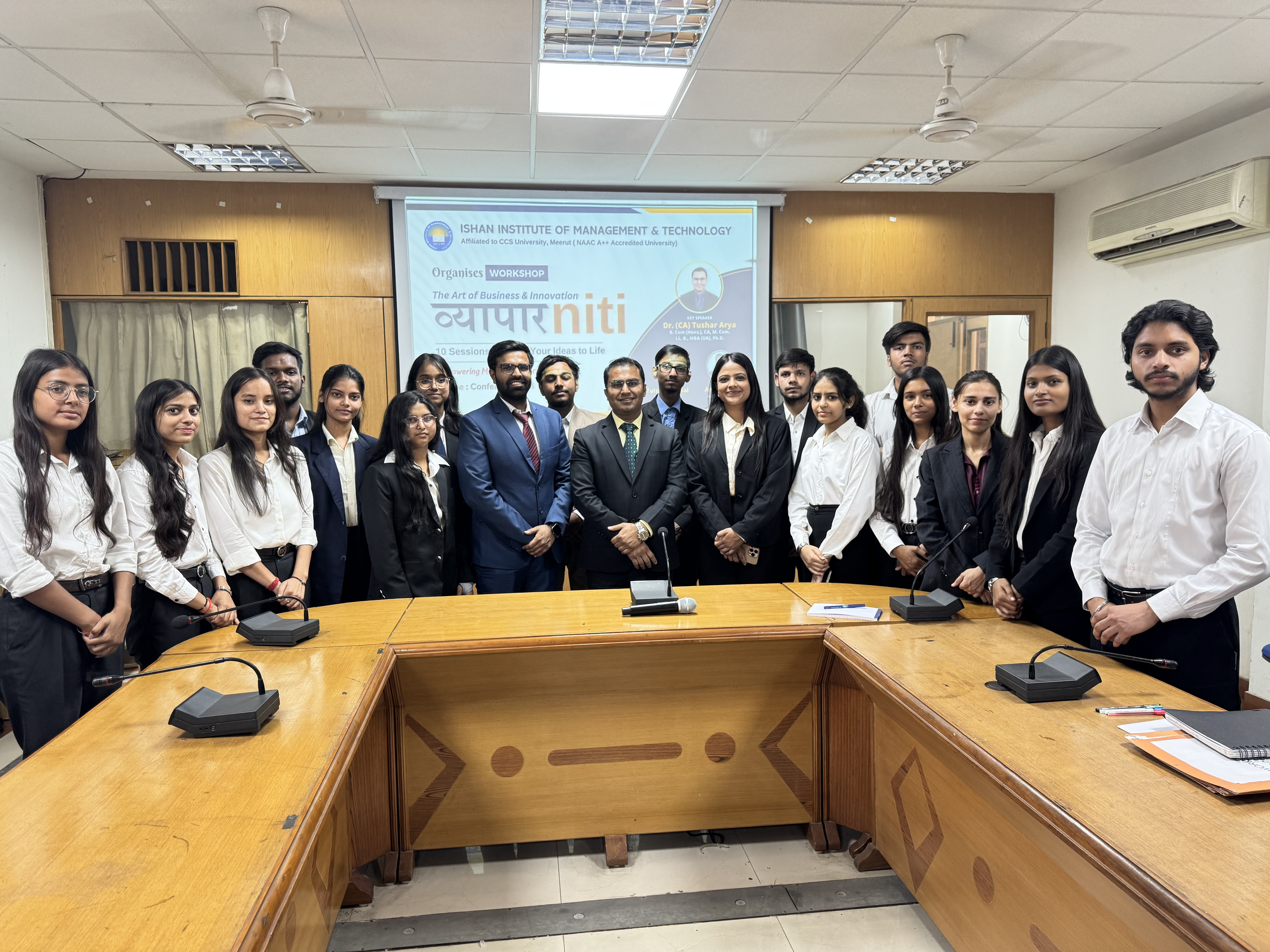
CA Dr. Tushar Arya honors Ishan IIMT student for international exposure at BBA program.
APPLY NOW

Ready to Join BBA?

Take the first step towards your dream career. Apply now or contact us for more information.

Contact Us

Start Your Journey

Fill in your details to apply

Apply Now

Student Details

+91

I authorize Ishan Institute of Management & Technology to contact me with notifications / updates via call / email / SMS / WhatsApp.